

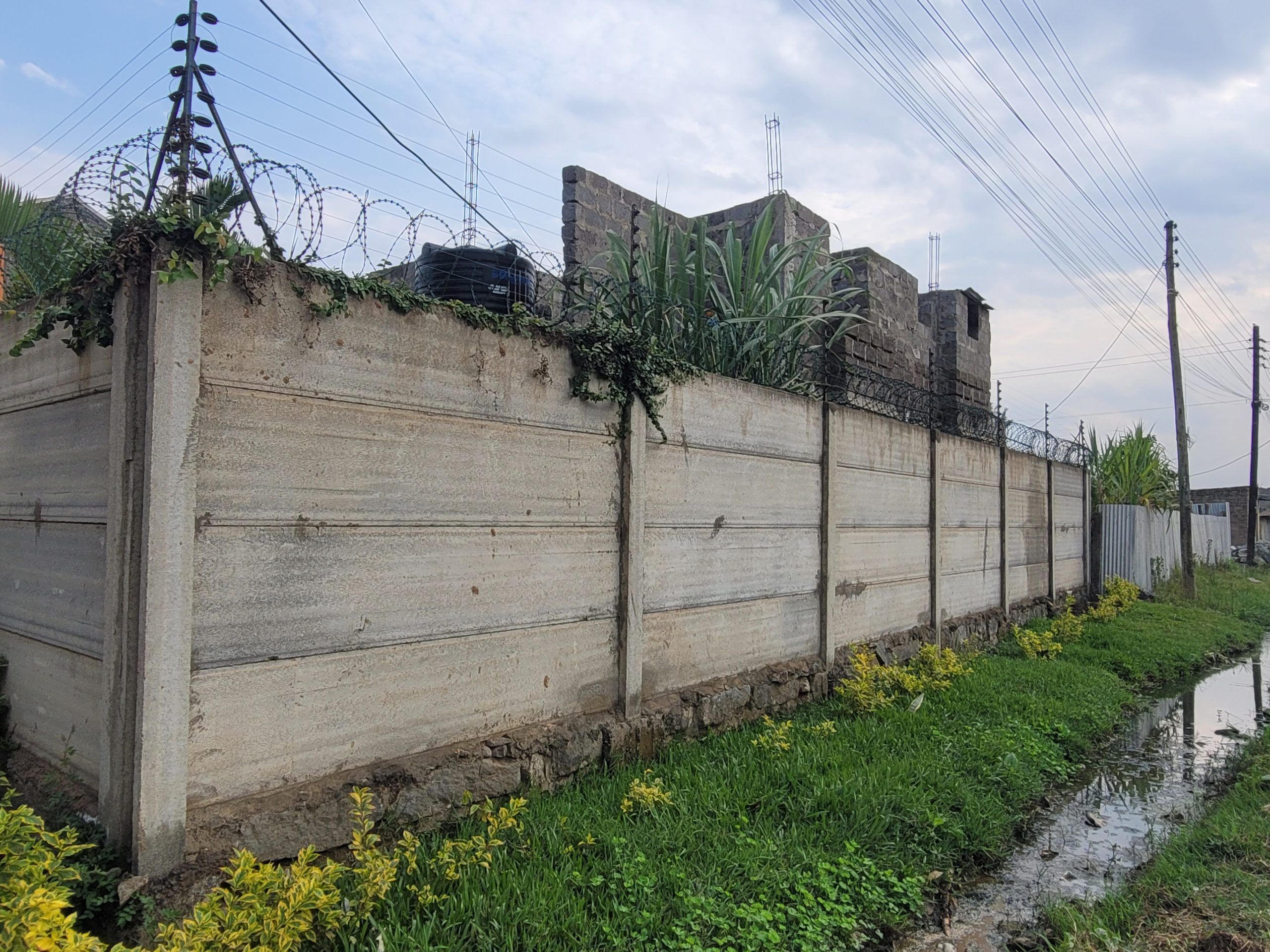
To build a precast perimeter wall, you will need wall panels, the kind used to build house walls, and H beams. The standard length of the wall panels for a perimeter wall is 3M. And that of H-beams is 3.1M. The H-beams have H-shaped grooves on both sides, allowing for the wall panels to be installed horizontally between them.
Given each panel has a width of 0.6M, four pieces will be required for each 3M space to achieve a 2.4M height for the precast fence. Considering the height of the fence is 2.4M, an extra 0.7M is left on the H-beam. (3.1 – 2.4). Normally, 0.6M goes under and is part of the foundation to guarantee the H-beams are firmly held on the ground, while the remaining 0.1M is left on top to add copings. See the image below.
However, if you want your precast fence higher than the standard 2.4M, you can opt to have an additional panel added to each space, bringing your total height to 3M. In this case, your H-beam will be 3.7M which is the maximum height for a structurally sound precast column.
Other components required for the precast perimeter wall are foundation stones, sand, ballast, and cement. These will be used to construct the foundation wall that will hold the H-beams or precast columns into place. Once the wall has cured through watering, the precast wall panels are installed by carefully inserting them into the H grooves. To eliminate squeakiness, a layer of plaster is added at the edges where the wall panels connect with the H-beams.
Pricing of the Precast Fence Materials
The wall panels and the H-beams are priced per meter. You can request a quote by filling out the popup form below. As for the foundation stones, ballast, sand, and cement, the price will vary depending on where you are based. Around Nairobi and its environs, foundation stone prices will range from Ksh 40 to 80 per foot. While a ton of sand and ballast will cost around Ksh 2400 each. As for cement, a bag goes for Ksh 850 as of August 2025.
How Much Would It Cost to Fence a 90M (50 by 100) Precast Perimeter Wall?
Precast fence calculations are simple. You only need to take the total length of your parcel of land that you intend to fence and convert it to meters. Then divided the number by 3, which is the length of the precast wall panels. This gives you the number of intervals between your walls.
In our case,
90/3 = 30 intervals
Each space takes four panels.
30 x 4 = 120 wall panels
For H-beams
It’s 30 pieces plus 1 to cover the other end. But, for every 30M, you need an extra H-beam to allow for expansion of the wall. Therefore,
90/3 = 3 plus 31, which comes to 34 H-beams.
Assuming each meter of a wall panel costs Ksh 880, then one 3M panel will cost around Ksh 2640.
So, 120 x 2640 = 316,800.
On the other hand, assuming each meter of an H-beam goes for Ksh 1150, then a 3.1M H-beam will cost around Ksh 3565.
This means
34 x 3565 = 121,210
Therefore, to fence the 90M perimeter wall, the precast materials alone will cost you around
316,800 + 121,800 = Ksh438,600
Other costs you can expect to incur as you build the precast perimeter wall include the cost of excavation, foundation stones, ballast, sand, and cement. As mentioned earlier, the cost of these materials will vary depending on where your project is based. Then there is a transportation fee for the precast materials and a labor cost for installation.
That said, a precast perimeter fence will set you back between Ksh6,500 and Ksh9,500 per running meter depending on economies of scale. This is incredibly cheap compared to the traditional brick and mortar fence that can cost you anywhere from Ksh10,500 to Ksh13,000 per running meter.
Time taken to build the precast perimeter wall
The duration it will take to build your precast fence will depend on the size of the project. However, you can count on unprecedented speed compared to your conventional brick and mortar. For our 90M precast perimeter wall, it’s around 4 to 5 days. The first day will involve excavation, mounting H-beams and building the foundation wall. A day is required for curing by pouring water before work is resumed on the third day or fourth day to install the panels.
You can learn more about how to use precast technology for your construction project by clicking here.